





As a SaaS company owner and an investor through Ramp Ventures, I’ve always got my ear to the ground when it comes to future trends.

And although there’s no way to predict with 100% accuracy what the upcoming year will bring, the following are a few of the trends I’m keeping an eye on in 2020:

Trend #1: A focus on sustainability 

A recent SaaStock article shared the following quote from Hanno Renner, CEO & Co-Founder, Personio:

“I think the biggest trends we’re currently seeing is that while growth remains important (especially at scale) it also gets more and more important to look at your metrics and remain profitable as we grow. Both from a growth margin but also from a customer acquisition perspective.”

I’m thrilled to see this idea gaining traction. I’ve been writing about the need for sustainability in growth since at least 2016, despite huge pressure at that point for companies to focus on scaling at all costs. 

That said, given that $100M+ equity financing rounds continue to increase – according to data shared by Sapphire Ventures – it’d be pretty naive to assume that founders and investors are going to suddenly back off on aggressive growth in order to focus on profitability and other sustainability metrics. 
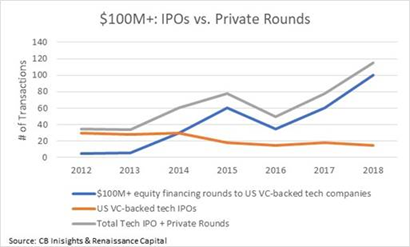
Image Source

But I’d still call it a win if even a small handful of startups take on this trend and decide to run with profitability as a north star in 2020. We’re all better off when growth is built on a strong foundation.

Trend #2: Specialization and differentiation

According to Blissfully’s 2019 Annual SaaS Trends Report, the average company spent $343,000 on SaaS in 2018 – a 78% increase from the previous year.

This kind of dramatic growth has only been possible because so many new products have entered the market in the last few years, and I don’t see that trend slowing down any time soon (barring major changes in the US economy, of course).

The natural response to these increased entries, in my opinion, is going to be specialization and differentiation, in terms of utility, features, audiences or verticals. 

When competition gets tougher, only those products that can clearly define a specific value proposition for a single audience and that can differentiate themselves from others are going to thrive.

Trend #3: Platform development (PaaS)

An alternative to serving a tightly-defined audience with a differentiated USP is to become a company’s “go to” platform for multiple needs.

Perhaps that’s why Linchpin SEO predicts growth in platform-as-a-service (PaaS) in 2020, writing that:

“PaaS focuses on allowing clients to create or purchase add-ons to the product that they initially bought. Doing so allows SaaS/PaaS providers to offer clients a much more personalized approach to their client’s needs, which should encourage their growth rate and customer retention.”

The challenge here is that developing a platform is harder than building a single solution tool – and it isn’t appropriate for many SaaS startups. If you haven’t hit product-market fit, for example, you’ve got more fundamental underlying issues to resolve before you start worrying about developing platform capabilities.

Trend #4: Product-led growth and product-specific KPIs

I wrote about one manifestation of this trend – the rise of product-led growth (PLG) – in another article. And although I stand by the questions I raised about the practice in that piece, it’s clear that growing acceptance of PLG is contributing to an increased focus on product in 2020.

Another way I expect we’ll see this trend take shape is in product-specific KPIs earning a bigger seat at the business table. This is something I’ve seen happening in my own companies, as we’ve been incorporating and prioritizing product KPIs into our monthly recaps and other review sessions for quite a while now.

Trend #5: A focus on customer experience and customer success

We’ve all seen the stats about the impact of creating strong customer experiences and investing in customer success. If you haven’t, it should be enough to know that B2B respondents in Econsultancy and Adobe’s most recent Digital Trends report ranked customer experience as the single most exciting opportunity for 2020:

Image Source

Investing in customer experience and customer success improves satisfaction, increases revenue, reduces churn and ensures LTV exceeds average CACs. If it isn’t a priority for your business yet, it should be in 2020.

Trend #6: Artificial intelligence (AI), virtual reality (VR) and machine learning (ML)

In a SaaS Mag article, Ismael Wrixen writes that:

“AI is no longer the ‘new kid on the block.’ Your Amazon Echo, chatbots, and Uber all rely on AI. The technology uses data and algorithms to predict, recommend, and automate processes covering anything from accounting to emails.”

In particular, Wrixen suggests that the impact of AI and related technologies will be seen most in personalization, automation and enhanced security. Integration with blockchain is another trend mentioned frequently in conjunction with these practices.

The bottom line? AI, VR and ML aren’t new. They should already be on your radar – at least in terms of understanding the particular applications they may or may not have for your product. And if they aren’t, make 2020 the year you do a full evaluation.

Trend #7: Increased investment in brand and thought leadership

Investing in thought leadership is something I’ve done for years, so I’m shocked that it hasn’t already taken off in a major way. Yet, according to Datapine’s Sandra Durcevic, Callbox data suggests that, “At present, only 24% of SaaS businesses publish content to educate or enlighten. Others are solely company-focused, and 11% of the primary players don’t even operate a blog.”

If you plan to make this a priority in 2020, check out any of the resources I’ve built on building thought leadership to help get you started:

Trend #8: Growing demand for API connections 

As API connections become more and more ubiquitous, SaaS companies that don’t offer them risk being left behind by clients who need them. Fortunately, adding one doesn’t have to mean making a major investment. DevSquad contributor Dayana Mayfield recommends that SaaS companies offer at least one or more of the following:

If building out your own API connections simply isn’t feasible, creating Zapier integrations or related connections can be a more reasonable approach.

Trend #9: Security issues

I don’t know if 2020 will be the year SaaS companies fully take responsibility for the security issues their products contribute to, but I hope so. As businesses and consumers embrace cloud computing to continually greater degrees, it’s up to SaaS product owners to make sure their trust isn’t misplaced.

In a presentation at Cisco Live 2018, Jonathan Rosenberg, vice president and chief technology officer in Cisco’s collaboration division, emphasized two major security risks endemic to SaaS usage:

  1. When companies use SaaS products, they’re effectively allowing “their data to be placed on multitenant servers, where it may commingle with others’ data. That creates a ‘honeypot’ problem, in which sensitive information is at greater risk because it is aggregated in one place. 
  2. According to Rosenberg, “data flows like water—all over the place.” Application data has become more diffuse, thanks to the widespread use of APIs and other permeable architectures. “All it takes is one compromised bit of code, copied and embedded in your company’s own app, and malicious actors are off to the races.”

Rosenberg offered several suggestions for SaaS companies who want to minimize their security risks, including the use of end-to-end encryption, PIN security and secure access features that can operate without a VPN

Trend #10: New payment models and unbundling of services

Jeff Curran, Director of Business Operations at OpenView Partners, predicts in an article on the company’s site that:

“In 2020, we’ll see companies unbundle their products. This happens when companies break products into smaller, modularized components aimed to solve a specific pain. As software deployment becomes easier and integration between products becomes better, customers are demanding best-in-breed solutions rather than all-in-one suites.”

To me, it’s interesting to see this trend alongside the one listed above about PaaS. Should companies niche down or unbundle products to serve customers who aren’t ready (or who don’t need) a full suite? Or should they double down on becoming all-in-one platforms incorporating multiple tools and supporting several different business needs?

I’m not sure there’s an answer that’s appropriate for every company. But recognizing that both forces are at work should make it easier for founders to figure out how to move forward.

Trend #11: Investment in talent

Finally, it’s worth noting that we’re in a period of record low unemployment rates – and that demand for talent in the tech sector is particularly competitive. 

That may change, but for now, I’m anticipating that SaaS companies will respond in 2020 by focusing on:

  • Increasing the size and scope of their recruitment practices to secure top talent with the help of recruitment software.
  • Deliberately creating small teams where team members feel their work is more impactful
  • Increasing investment in professional development opportunities to retain existing team members
  • The future of work is expected to be heavily geared towards remote working. Offering remote work arrangements and other non-traditional benefits can help prevent turnover.

Given the potential for domestic and global volatility we’re already seeing in 2020, it’s anyone’s guess how the year will actually proceed. Any number of circumstances could alter trajectories in the tech sector. But until that happens, paying attention to the trends we’re seeing evidence of now is the smartest course of action for staying competitive.

What other trends are you watching in 2020? Leave a note below sharing your predictions:

Onboarding: The Most Important Growth Lever

Onboarding is the process of turning new sign-ups into “active” users by helping them learn how to use a product and get maximum value from it or better yet, solve their problems / pain points.

It enhances the customer experience by educating users, which ups the odds that a user will become a long-term customer. This is so important – especially in 2018 – because it’s easier than ever to acquire customers (or in other words, for your competitors to take yours away). If you want to succeed, it’s retention, not acquisition, that should be your main focus.

Those who are new to the SaaS game (or other user-led platforms, like social media sites) may get excited by new sign-ups, but when 40-60% of software users use a product just one time, that excitement is clearly premature.

Here’s why that’s a problem.

Continue reading Onboarding: The Most Important Growth Lever

I’m passionate about sharing everything I know on SaaS business, so it’s not a huge surprise that I often hear the question, “How do I sell my company?”

The answer? I believe that you don’t just decide to sell, and then make it happen. The most successful people I know make a conscious decision regarding the kind of exit they want to have, and then they follow a carefully designed plan to make it happen.

That’s why I was so excited to sit down recently with Mac Lackey, founder of Exit DNA. Mac is a career entrepreneur who’s started, scaled, and exited six companies over the past 25 years, and who’s acted as a mentor, advisor, and investor in many others.

Mac and I met recently at Baby Bathwater in Croatia, and he was generous enough to sit down for a series of interviews with me on planning proactively for an exit.

Preparing Your Company to Be Sold

One of Mac’s best pieces of advice to come out of our conversation is that, “Companies are not bought. Companies are sold.” According to Mac, most entrepreneurs think they’re building something so valuable that an investor will eventually come pounding down their doors, offering to pay a premium for their companies. But that’s not something that happens very often. 

Instead, Mac says, “As founders, we have to proactively design our companies so that they can be sold.” Fortunately, he continues, “there are a lot of simple things that you can do early in the process. If you decide you want to sell your company in a year or two, you can start adjusting and making changes now so that you can get a compounding effect that creates real value.”

Mac suggests having at least a 12-24 month horizon to make your company as valuable as possible. During that time, he recommends that founders ask themselves, “How would a buyer view this decision? What would a prospective buyer of my company think about this new hire, this new campaign, this new office, or this write off?”

I’m a big believer in this as well. At Ramp Ventures, all of our companies are built to be sold or operated to be sold – and since that’s our goal, we operate clean P&Ls. We aren’t writing off car payments or going out to fancy dinners. We’re making sure that every dollar we spend and every employee we hire is focused on maximizing our exit value.

Selling Based on Strategic Value, Not Financial Metrics

Since everyone wants to talk numbers when it comes to exit planning, I found Mac’s take on selling based on strategic value refreshing.

He explains, “One of the exercises I often take people through early in the process is an analysis that looks at their company through a pure financial lens. So, if you took some really common multiples of EBITDA and revenue, and you looked at those, the question is, ‘Would you sell your company for plus or minus 10% of that number?’ Most entrepreneurs immediately say, ‘Oh my gosh, I would never sell it for 5X EBITDA. That’s not a big enough number.’”

According to Mac, that friction means that founders need to focus on increasing the value – or the perceived value – of their companies through nonfinancial measures. He states, “I never once sold a company based on a financial multiple. It was always based on strategic value, and that’s where the premiums are. If you focus in on financial metrics and multiples, you’re leaving a lot of value on the table. As a founder, one of the things you can do is really turn up the volume on that strategic value.”

One way this happens comes from helping prospective buyers to envision your company as part of theirs. As Mac notes, “Now, you’re not really selling your business. You’re selling your business within their framework.” Mac gives the example of a company with a massive sales force that could easily multiply what you’re doing on a much smaller scale as a small team. “You’re starting to get them to see what’s possible. And when you sell what’s possible, the sky’s the limit.” 

How Mac Sold a Tech Startup to NBC

Mac speaks from experience, having used this approach to sell a tech startup to NBC Sports. 

“We had a software business that was a technology company focused on youth sports, specifically in the category of soccer,” he describes. “We started thinking about all of the different people who could benefit from the technology that we were building. I created a list of prospective buyers, probably 90% of whom I didn’t know at all, and I started proactively picking up the phone and calling the CEOs.”

Though Mac wasn’t yet selling, he explains, “what I wanted to do was to be on their radar at a time when I wasn’t actually in the market selling. I wanted them to know who I was, what our company was, and what our goals were, so that the next time I spoke to them – whether it was proactively, or if I ran into them at a trade show, or if they called me – I could give them an update, and the progress I’d made would be an eye opener.”

Throughout this process, Mac ended up connecting with a division lead at NBC Sports. “We started this dialogue about our company and how it would fit into the fabric of NBC Sports,” Mac notes. “Once that became a, ‘We would like to talk about joint ventures or buying your company’ conversation, I hit pause, went out and created a market. I found other prospective buyers so that we could create a bidding war on our company, though we ultimately did sell the company to NBC Sports.”

Being proactive certainly played a role in Mac’s success, but he also attributes the outcome of his exit to the story he told as part of the process. He explains, “If you looked at the two or three companies that were ultimately in the bidding process, I had the same company, the same assets, and the same value, but the story I told to the prospective buyers was very different.”

In one case, Mac describes, “We believed that we had a really strong offering, and we had 6,000 of the 9,000 youth clubs in the country on our platform. But I had one sales person. The prospective buyer had 80. So I was able to tell the story of ‘Imagine if you owned our company, and you had our technology and your Salesforce. Imagine if you just picked up the phone and started calling. What do you think would happen?’”

According to Mac, “Not one ounce of that was a discussion of our financial metrics, our revenue, or our EBITDA. It was a story of what’s possible, and of telling different stories to different prospective buyers.”

How to Identify Strategic Buyers

To Mac, NBC Sports was a strategic buyer. “In the marketplace, generally speaking,” he explains, “there are a couple of different categories of buyers for companies. The first category is a financial buyer. That’s what we typically think of as private equity firms, hedge funds, or someone that’s buying the business not because of its assets, but based on the financial performance of the business.”

By contrast, he notes, “The strategic buyer market is much broader. Strategic buyers can be anyone that identifies something in your organization that has strategic value to them. It could be intellectual property that you’ve created, trademarks, copyrights, or patents. It could be technology that you’ve built that’s unique. It could be your team. Or it could be a geography that you serve that this buyer is interested in moving into.”

Mac believes that founders have an obligation to create a market of strategic buyers for their companies. “What I tend to do is start with the path of least resistance,” he describes. “Whatever industry you’re in, a bigger version of your organization is a strategic buyer. If you’re a software company, there’s someone in the U.S or in the world that’s doing what you’re doing at a much bigger level. That’s a very easy example of a strategic buyer that is effectively a competitor.”

From there, Mac recommends expanding your search by degrees. “Let’s say you’re a SaaS company working with lawn care businesses. Then you would say, ‘All right, well there are other software as a service providers that are in the industry, but that are not specifically in lawn care.’ They’re in home. They’re in maintenance, or they’re in something a little bit broader. But maybe they don’t have a really strong offering in that little niche, so you broaden it out.”

He continues, “Then you go out another layer and say, ‘All right, well who is an organization that wants to have a relationship with a homeowner?’ And they may not have any offering in this category, but what their real driver is, is the relationship with the homeowner. You have to think about your company and what you potentially could offer to any type of buyer. What I end up doing is creating a spreadsheet with columns for different industries, and then below that I just start listing companies.”

Mac also creates Google alerts for the companies he identifies as part of this process in order to get updates on what they’re doing or talking about. He explains, “They will almost always tell you in their news stories, press releases, and podcast interviews. The CEO will be talking about their vision, their next product, their goals, and their ambitions. When you pick up the phone and call that CEO, not only are you a solution for that organization, you know exactly what the CEO has been telling the market he wants.”

To Mac, it’s all about the process. He recommends, “Even if it’s once a week in your calendar, have 20 or 30 minutes where you’re thinking about your universe of prospective buyers and your value proposition to them. It starts to become a roadmap to building value, because you start to identify gaps in the market that may be some of your big competitors aren’t addressing.”

Building Relationships with Strategic Buyers

As you’re forming these connections, Mac recommends identifying potential stakeholders at all levels. “Some people have all kinds of filters in front of them,” he notes. “So if it’s a CEO of a large company, they might have two or three roadblocks. You might not be able to get a face to face meeting quickly. If that’s the case, you’re looking for someone in strategic finance. You’re looking for someone in corporate development or business development that’s out in the market looking for opportunities.” 

Far from being wasted effort, Mac explains that, “A lot of times, what ends up being an acquisition or a merger starts out as a joint venture, a distribution, or a partnership. So if you’re reaching out at a lower level, you can talk about how your organization can take theirs to another level. That’s of interest to someone in sales or corporate development. The more you navigate that process, sometimes it becomes apparent that you have an opportunity to sell your business.”

One final tip Mac offers is to be active within your industry. “Every industry has trade shows and events that prospective buyers – hopefully at the highest level, if not their key lieutenants – attend. Your ability to be present and visible at these events is a great strategy for building relationships with strategic buyers.”

For even more of Mac’s wisdom, visit his website to check out his personal blog or learn more about the Exit DNA program. 

Image Source: Unsplash

In his book, Outliers, Malcolm Gladwell makes the claim that it takes 10,000 hours to become an expert on something. And although plenty of people have written about why Gladwell’s claim may or may not hold up, 10,000 hours is still roughly equivalent to five years of full-time work, if you estimate 40 hours per week over 50 weeks each year.

And if you ask me? That’s easily long enough to go from a beginner to an expert on plenty of different subjects.

I’ve seen the impact of investing 10,000 hours into something new in my own career. After I left Single Grain in 2014, I took a position as the head of marketing at a SaaS company – not only because I wanted to grow the company, but because I wanted to learn everything I could about product.

And although I can’t say I’m truly an “expert” on the subject, I’ve come a long ways over the past five years. Here, I’ll share some of the lessons on successfully growing a product that I’ve learned from that initial role, as well as from all the companies I’ve built or acquired since.

Lesson #1: Customers don’t always know what they want 

Here’s the thing. Customers are really good at giving product feedback – and they’re really good at shitting all over things that don’t work. But that’s not the same as knowing what they actually want.

Let me give you an example. At Pick.co, which my company acquired in 2016, we made it a huge priority to listen directly to customers. From about 2016 to mid-2017, we went out and specifically talked to 50-75 customers about what they wanted.

This gave us some great insight, but the problem was that every customer we talked to was saying something different. They all had different workflows. So when we went out and actually built what they’d said they wanted? We wound up eventually having to scrap pretty much everything we’d created. 

We didn’t realize it at the time, but we were asking the wrong questions. 

Lesson #2: Learn to ask the right questions

One of the biggest challenges in product – especially in SaaS – is that you’re often creating something that’s going to be revolutionary or that requires changing habits.

Think about it. People didn’t use cell phones before they were cell phones, and they didn’t buy on mobile devices before there were people selling on mobile devices.

Sometimes, what you need to build is different than what people are doing now – and that’s what makes asking the right questions so critical when capturing customer feedback. 

Unfortunately, there’s no set of “right questions” out there. It’s more about demonstrating your idea, sharing it, and seeing if it’s valuable enough or if it offers a big enough benefit to get people to change their habits.

At Mailshake, when we talked to customers, we’d hear all sorts of feedback around making the product “easier to use.” But when we dug deeper, customers had dozens of different reasons it was too difficult to use. Looking even more closely, it was clear that people were just failing to use the features we already had in place.

If we’d listened to customers’ prescriptive ideas of what to change, we’d have made the product worse for other users. But by looking at the product in terms of where people were failing, we were able to fix workflows and solve their problems – all without changing the product.  

If you aren’t asking the right questions and digging deeper into the responses you’re receiving, you’re going to miss out on these opportunities.

Lesson #3: Simple products are almost always better than feature-rich products

Here’s a big lesson I learned. There are always ways to iterate products to add functionality and make them more robust. But ultimately, what people crave is something they can jump into and figure out immediately, without having to go through a lot of training or change their behavior. 

So, knowing that, the challenge becomes, “How can I remove friction points in what I need people to do to get started?”

Take Mailshake as an example, again. If you’re going to use the product for sales, you have to know how to write copy, how to find and identify your potential customers, what kind of cadence you’re going to use to follow-up, etc. 

Despite that, we knew we couldn’t make the first thing new users have to do be to go watch a video. They’re not going to watch it. They just need to know the first thing they have to do, and they have to buy into it. After that, they’re more invested, and they’re more likely to do the second thing, and then the third thing, and the fourth thing, and so on.

The same goes for writing email copy. The first thing people have to do with Mailshake is add email addresses and start a campaign. If they can’t write email copy yet, they can use templates or draw on other sources. But if we decided we had to teach everybody how to write copy from day one, they’d become experts in copywriting – but they still wouldn’t be any closer to sending a campaign or getting results. 

As it stands, copywriting feedback is currently several steps into Mailshake’s onboarding process, and that’s by design. We’ve learned that, by that point, they’re invested enough to do the really hard thing in ways they wouldn’t be if we started with that training.

The bottom line? Keep things simple. Focus on the first interaction, and then move on to the second interaction once you’ve nailed that. Keep going, focusing on removing friction along the way. 

Lesson #4: What worked for other companies won’t necessarily work for you

I’m going to be blunt. You could take the exact same steps as Dropbox, but you’re not going to be the next Dropbox. It just doesn’t work that way.

Part of it is timing. Other companies launched at a different time than you. They may have had more users when they launched, or they may have had a lot fewer competitors because of their timing.

Misinformation is a problem as well. No matter how much info a company publishes, you’re never going to fully understand what happened behind the scenes that led to a success. Maybe people misquoted, misread or misinterpreted how valuable something was in a company’s growth. If you try to build your own business based on this misinformation – even if you don’t realize you’re doing it – you’re always going to come up short.

So what do you do instead? Use the lessons from the greats as good inspiration, but find a way to put your own spin on it.

For example, Dropbox’s model may not work the same way anymore, but email optimization startup Superhuman is still making the referral program model work by adding a different hook of personalized onboarding to build up hype.

But even Superhuman’s approach might not work for you. You have to do the math.

For example, say you decide to spend money on PPC. How much traffic will your campaigns generate? How much are they going to cost? What’s going to convert for users, how’s that going to convert to paid and how many users is that going to get you? 

If you decide to focus on SEO instead, know that that’s going to take some time. Even partnerships aren’t guaranteed wins. You have to look at how much traffic they’ll bring in, and how many signups you think you’ll be able to close as a result.

Lesson #5: If you build a good product, it’ll do the marketing for you

If you build the right product, and you find the one or two channels that grow your company, eventually – when you get enough people through the door – going through the flow of your product can become your primary growth driver.

But for that to work, you have to get your first 100-200 people to go through the door.

One way we’ve done that at Mailshake and at a lot of our other companies is to launch a lifetime deal upfront. I’ve heard from people who thought that was diminishing our value. But the way I look at it, we were able to get thousands of people in the door who basically paid me to give me feedback, and who helped kickstart our referral marketing. 

But again, that was 4-5 years ago. Even launching lifetime deals doesn’t work the same way now. You still have to figure out a way to put your own spin on the model.

Lesson #6: The best products become platforms

According to Ajay Agrawal, the difference between products and platforms is that:

  • Product = an application to solve a specific problem or use case
  • Platform = common infrastructure essential to multiple applications

Ajay offers Salesforce as an example, explaining that, “Salesforce’s core CRM evolved into a broader platform for enterprise applications, helping it become the first dedicated SaaS company with $10 billion in annual revenue.”

That transition didn’t happen overnight for Salesforce – and it won’t happen for you either. But if you can make the leap from product to platform, do so. If you can become a platform, people will never leave. 

Lesson #7: Great products can be hiding behind flawed assumptions

This was a surprising lesson for me. Sometimes, parts of your product can be awesome, but the things that are either in front of it or around it can bring it down. 

Some of you might remember that, when we started Mailshake, it was actually called ContentMarketer.io. Like Mailshake, ContentMarketer offered email sequences, but it also helped you find influencers’ email addresses, find their social profiles, and reach out to them while scanning blog posts.

What happened was that people loved the email sequence part of the tool, but nobody used the other parts. We got lucky that we built one component right from the beginning, but no one ever really used it because the rest of the product wasn’t up to snuff for our customers. It took us about almost a year to figure that out and to change course to building Mailshake.

If you’re struggling to get traction, that doesn’t mean your entire product is flawed. Find out what’s awesome about what you’ve built and focus on it – even if it’s not what you initially imagined customers would value. 

Lesson #8: Product is hard

It’s that simple. There’s no right way to do product, and there’s no easy way to learn it. 

You can read all about product. I’ve read dozens of books on product management, talked to lots and lots of experts, and spent the last five years basically obsessing over product. 

But the reality is, it’s going out and doing it – talking to customers, getting feedback, asking the right questions, and rinsing and repeating this whole thing over and over again – that helps you find your special sauce.

I’m still not an expert, but every year, I moved another notch up until – all of a sudden – the pieces of the puzzle just clicked together and left me with an unofficial product management philosophy I didn’t have before.

Your process will be different. You might only need a few years of boots-on-the-ground experience to master product, or you might need decades. The only real way to know is to get in the arena, get your hands dirty, and treat every experience as an opportunity to learn a new lesson.

What lessons can you add to this list? Leave me a note below sharing your own product management experiences:

Photo by Austin Distel on Unsplash

Even if you’ve never heard of Syed Balhki, you’ve definitely been on one of his websites (or at least a website that uses the technology he’s created). As the founder of OptinMonster, WPBeginner, WPForms and other resources, his software is currently running on more than nine million websites worldwide.

I recently had a chance to sit down and chat with Syed, and if you’re a serial entrepreneur – in practice or at heart – you’ll love the key tips and takeaways that came out of our conversation.

Continue reading A Conversation with Syed Balkhi: Wisdom for Serial Entrepreneurs

In my last article on B2B marketing, I took a deep dive into the different trends marketers need to be aware of as we get closer to 2020. 

The article covers a lot of territory, so if you’re feeling overwhelmed, you’re in luck. Today, I’ve pulled together 17 of my favorite B2B marketing blogs and communities that serve up great information on the tactics and trends we all need to be aware of.

Check them out, pick your favorites and make ongoing education a priority this year and into 2020.

Continue reading The 17 Best B2B Marketing Blogs & Communities in 2019

Reading helpful blogs and participating in industry communities are two great ways to hone your B2B marketing skills. But if you really want to take your professional development to another level, consider attending a marketing conference in person.

Yes, I know it’s pricey. Tickets for these kinds of events generally aren’t cheap, and adding travel expenses on top can feel cost-prohibitive. 

But there are two things that make the investment worthwhile. First, there’s the hands-on learning. Hearing an inspiring speaker share cutting-edge tactics and techniques can be 10x more impactful than reading similar material on your own. Keynote speakers and panelists are one of the most important aspects of a successful virtual event. Know how to acquire the best talent for your virtual event.

Continue reading The Top 21 B2B Marketing Conferences to Attend in 2020

When it comes to customer success, every year brings with it a new set of trends. Some of these may be fleeting fashions, but more commonly, they reflect bigger trends in tech advancements and data-based business processes, as well as attitudinal changes between customers and businesses. 

So as we come to the end of 2019, let’s look back at some of the trends we’ve seen over the last few months, as well as what we can expect as we draw closer to the new year. 

Continue reading The Top 9 Customer Success Trends Going Into 2020

If you’ve spent any length of time in digital marketing, you know the man, the myth, the legend, Neil Patel. But besides running CrazyEgg, Neil Patel Digital, Ubersuggest and a handful of other companies, he’s also my cousin. 

Recently, I sat down with Neil to get his insight on everything from hiring to his biggest SEO wins. Here are some of the top takeaways from our conversation.

Continue reading Hiring Talent, Running Multiple Companies and Winning With SEO: Business Lessons From Neil Patel

There’s never been a better time to find a job working in customer success.

Companies around the world are waking up to the fact that investing in customer success produces real results. We know, for example, that companies that prioritize the customer experience can generate 60% higher profits than their competitors. And that even something as small as a 5% increase in retention can result in a 75% increase in business profits.

Want to be a part of helping companies achieve results like these? Build a career working in customer success.

Continue reading How to Get a Job in Customer Success